Exploring Quantum Technology Principles
Discover how quantum technology uses superposition and entanglement to revolutionize computation and secure communications.
WAWSF Insight: Exploring why this story matters for Technology & Innovation.
Today, quantum technology, leveraging principles like superposition and entanglement, is set to revolutionize computation and secure communications. How will these advancements tackle complex global challenges? The urgency lies in its potential to redefine industries and enhance global connectivity, making it a pivotal focus for sustainable development.
According to a report by Jülich Research Centre, the issue has gained global attention across Technology & Innovation.
Understanding Quantum Technology
Quantum technology is a groundbreaking field that leverages the unique phenomena of quantum physics to create devices and systems that outperform their classical counterparts. At its core, quantum technology relies on principles such as superposition and entanglement. Superposition allows quantum bits, or qubits, to exist in multiple states simultaneously. This capability enables parallel computation, vastly increasing the potential computational power compared to classical bits, which can only be in one state at a time. Entanglement, another fundamental principle, links particles in such a way that the measurement of one particle instantly influences the state of another, regardless of the distance separating them. This phenomenon is pivotal in developing secure communication systems and enhancing computational capabilities. By harnessing these principles, quantum technology opens new avenues for innovation and problem-solving, offering transformative potential across various industries.

How Quantum Systems Operate
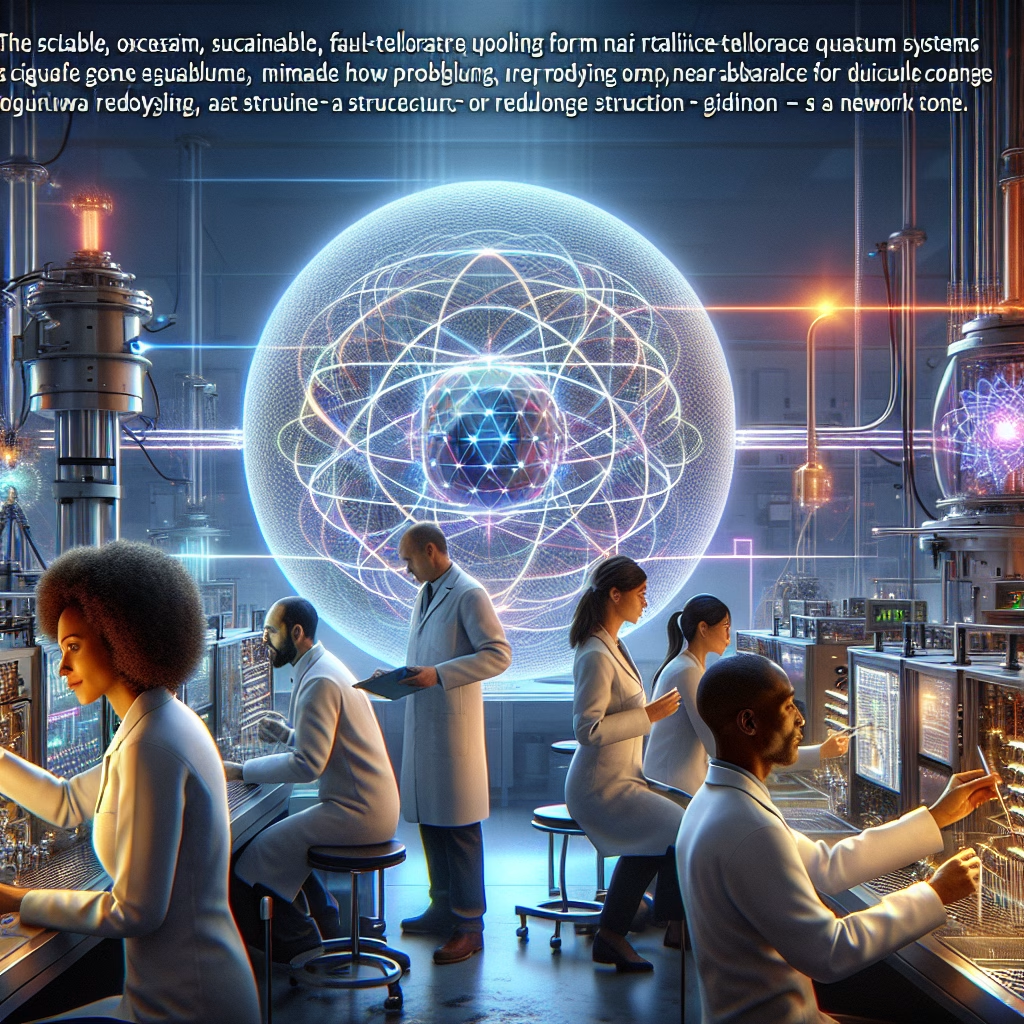
The operation of quantum systems hinges on the delicate maintenance of qubits, which are the fundamental units of quantum information. To preserve their coherence, qubits are often kept at cryogenic temperatures, minimizing thermal noise that can disrupt their quantum states. Additionally, error correction techniques are employed to ensure the accuracy of quantum computations. These methods are crucial for performing gate operations, which are the building blocks of quantum algorithms. Quantum gates manipulate qubit states through precise interventions such as laser pulses or microwave signals, conducted in highly controlled environments. These operations allow for the execution of complex quantum algorithms, paving the way for unprecedented computational capabilities. The intricate balance of maintaining qubit coherence and executing precise gate operations underscores the sophistication and potential of quantum technology.
Transformative Impact of Quantum Technology
Quantum technology holds the promise of significantly optimizing energy-intensive processes, particularly in fields like material simulations for sustainable chemistry and renewable energy. By enabling more efficient simulations, quantum technology can contribute to the development of eco-friendly materials and energy solutions. Economically, the acceleration of innovation in semiconductors, pharmaceuticals, and cryptography is expected to foster new industries and economic growth. The ability to perform complex computations at unprecedented speeds can lead to breakthroughs in drug discovery and secure data encryption, driving advancements in these sectors. Societally, quantum technology enhances secure communications and precision medicine through advanced sensing and modeling techniques. These advancements can lead to more robust cybersecurity measures and personalized medical treatments, improving overall quality of life and societal well-being.
Integrating Quantum with Broader Systems
Quantum technology is increasingly linked to artificial intelligence through hybrid quantum-classical algorithms that optimize machine learning processes. This integration allows for more efficient data processing and decision-making, enhancing the capabilities of AI systems. Additionally, quantum technology intersects with materials science, enabling the development of novel heterostructures and energy-efficient devices. These connections highlight the interdisciplinary nature of quantum technology, as it collaborates with other fields to push the boundaries of innovation. By bridging these domains, quantum technology not only advances its own field but also contributes to broader technological ecosystems, fostering a collaborative environment for future advancements.
The Future of Quantum Technology
The future of quantum technology is poised to address some of the most intractable problems in logistics and drug discovery through scalable, fault-tolerant systems. These systems promise to revolutionize industries by providing solutions that are currently beyond the reach of classical computing. As quantum networks evolve, they may form the backbone of global secure communication infrastructures, offering unparalleled security in data transmission. This development could redefine how information is shared and protected on a global scale. The potential for quantum technology to transform various sectors is immense, as it continues to evolve and integrate with existing technologies, paving the way for a future where complex problems are solved with unprecedented efficiency and security.
Editorial Reflection
Quantum technology, driven by principles like superposition and entanglement, is set to revolutionize computation and communication. Its impact spans environmental, economic, and societal domains, promising significant advancements.
This development highlights a shift towards more integrated and efficient technological solutions, reflecting broader trends in innovation and interdisciplinary collaboration.
As quantum technology advances, it will influence industries and policies, offering new opportunities for growth and security, impacting how we approach complex challenges.
This story sheds light on broader implications in Technology & Innovation, encouraging readers to reflect on its impact.

Scholar Idea
✅ FACT-CHECKED & VERIFIED:
This article was prepared based on verified information from
Quantum Photonics and Technologies Research Positions.
Our editorial team ensures accuracy through cross-referencing reliable and well-established international organizations.
Sources
https://scholaridea.com/2026/02/20/julich-research-centre-in-germany-invites-applications-for-vacant-61-master-phd-and-postdoc-scholarships/
https://www.quantum-australia.com/