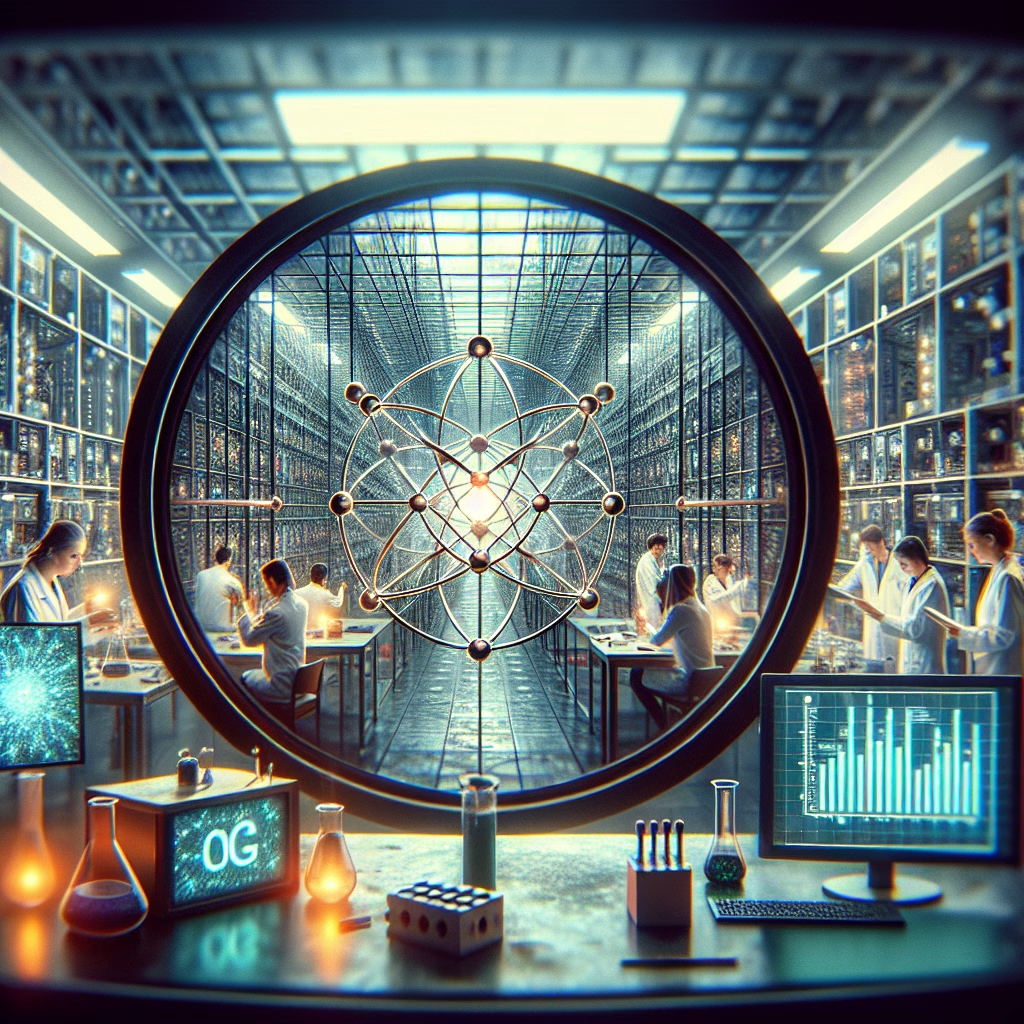
Quantum Computing: Principles, Qubits, and Impact
Explore quantum computing fundamentals, qubits, and its transformative impact on technology and society.
WAWSF Insight: Exploring why this story matters for Technology & Innovation.
Today, quantum computing leverages quantum mechanics to revolutionize problem-solving, promising breakthroughs in materials, cryptography, and more. How do quantum computers work to achieve such efficiency? As technology advances, understanding quantum computing is crucial for navigating future shifts in industry and innovation.
According to a report by Cambridge University Press, the issue has gained global attention across Technology & Innovation.
Understanding Quantum Computing
Quantum computing represents a revolutionary model of computation that leverages the peculiarities of quantum mechanics to process information. Unlike classical bits, which exist in a state of either 0 or 1, quantum bits, or qubits, can exist in a superposition of states. This means a qubit can simultaneously represent both 0 and 1, allowing quantum algorithms to explore vast computational spaces in parallel. This capability is not just theoretical; it underpins the potential for quantum computers to solve certain problems much faster than classical computers.
Another fundamental principle of quantum computing is entanglement. When qubits become entangled, the state of one qubit becomes dependent on the state of another, no matter the distance between them. This non-classical correlation allows quantum algorithms to amplify desired outcomes while suppressing others, providing significant speedups in tasks such as searching databases, factoring large numbers, and simulating quantum systems. Together, superposition and entanglement form the core principles that make quantum computing a powerful tool for tackling complex computational challenges.

How Quantum Computers Operate
At the heart of a quantum computer lies the orchestration of sequences of reversible quantum gates applied to qubits. These gates manipulate qubits through unitary evolution, implementing the desired algorithm. Once the computation is complete, measurement collapses the quantum state into classical outcomes, with probabilities influenced by quantum interference. This process allows quantum computers to perform calculations that would be infeasible for classical systems.
Building a practical quantum computer involves more than just theoretical principles. It requires physical implementations of qubits, which can be realized through various technologies such as superconducting circuits or trapped ions. Control electronics are essential for managing these qubits, and error mitigation techniques are crucial to protect fragile quantum information from decoherence and noise. Ultimately, quantum error correction is necessary, encoding logical qubits into many physical qubits to ensure reliable computation. This complex interplay of components and processes is what makes quantum computing both a challenging and promising field.
The Transformative Impact of Quantum Computing
Quantum computing holds the potential to revolutionize environmental sustainability through quantum simulation. By accelerating the discovery of catalysts, materials, and chemical processes, it can lead to the development of more efficient fertilizers, batteries, and industrial reactions. These advancements promise to lower energy consumption and emissions, contributing to a reduced ecological footprint.
Economically, quantum computing offers significant speedups in optimization, logistics, portfolio construction, and material design. These improvements can alter cost structures and create new industries centered around quantum-enabled services. Organizations that integrate quantum expertise and infrastructure are likely to gain a competitive edge, reshaping the economic landscape.
On a societal level, quantum computing will redefine digital security, healthcare, and critical infrastructure. The advent of post-quantum cryptography and quantum-secure communication will necessitate new skills and governance frameworks. Advances in drug and material discovery will enhance healthcare outcomes, while international coordination will be essential to manage these transformative changes.
Quantum Computing and Broader Technological Systems
Quantum computing is intricately linked to modern cryptography. Algorithms like Shor’s algorithm pose a threat to widely used public-key cryptographic schemes, driving the development of quantum-resistant cryptographic primitives. This connection underscores the need for a new generation of secure communication protocols that can withstand the capabilities of quantum computers.
Furthermore, quantum computing intersects with high-performance computing and artificial intelligence. Hybrid architectures are emerging where quantum processors serve as specialized accelerators for tasks such as simulation, sampling, and certain machine learning subroutines. This integration highlights the complementary nature of quantum and classical computing, paving the way for more powerful and efficient computational systems.
The Future of Quantum Computing
The path to logical, fault-tolerant quantum computers involves gradual scaling, improved coherence, and robust error correction. Initially, these advancements will lead to domain-specific advantages in fields like chemistry, optimization, and secure communication. Rather than providing universal speedups for all tasks, quantum computing will first excel in areas where its unique capabilities offer the most significant benefits.
Over time, quantum computing is expected to evolve into an integrated layer of the digital infrastructure. It will be accessed via cloud platforms and combined with classical and neuromorphic systems. This evolution will reshape how complex decisions, designs, and simulations are computed, offering new possibilities for innovation and problem-solving. As quantum computing becomes more accessible, it will transform industries and redefine the technological landscape.
Editorial Reflection
Quantum computing leverages quantum mechanics to process information in ways classical computers cannot, promising transformative impacts across various sectors.
This development highlights a shift towards more integrated and powerful computational systems, reflecting broader technological advancements and societal adaptation.
As quantum computing evolves, it will influence industries, policies, and everyday life, necessitating new skills and frameworks to harness its potential effectively.
This story sheds light on broader implications in Technology & Innovation, encouraging readers to reflect on its impact.

Cambridge Core
✅ FACT-CHECKED & VERIFIED:
This article was prepared based on verified information from
Quantum Computation and Quantum Information.
Our editorial team ensures accuracy through cross-referencing reliable and well-established international organizations.
Sources
https://www.nature.com/subjects/quantum-computing
https://csrc.nist.gov/projects/post-quantum-cryptography