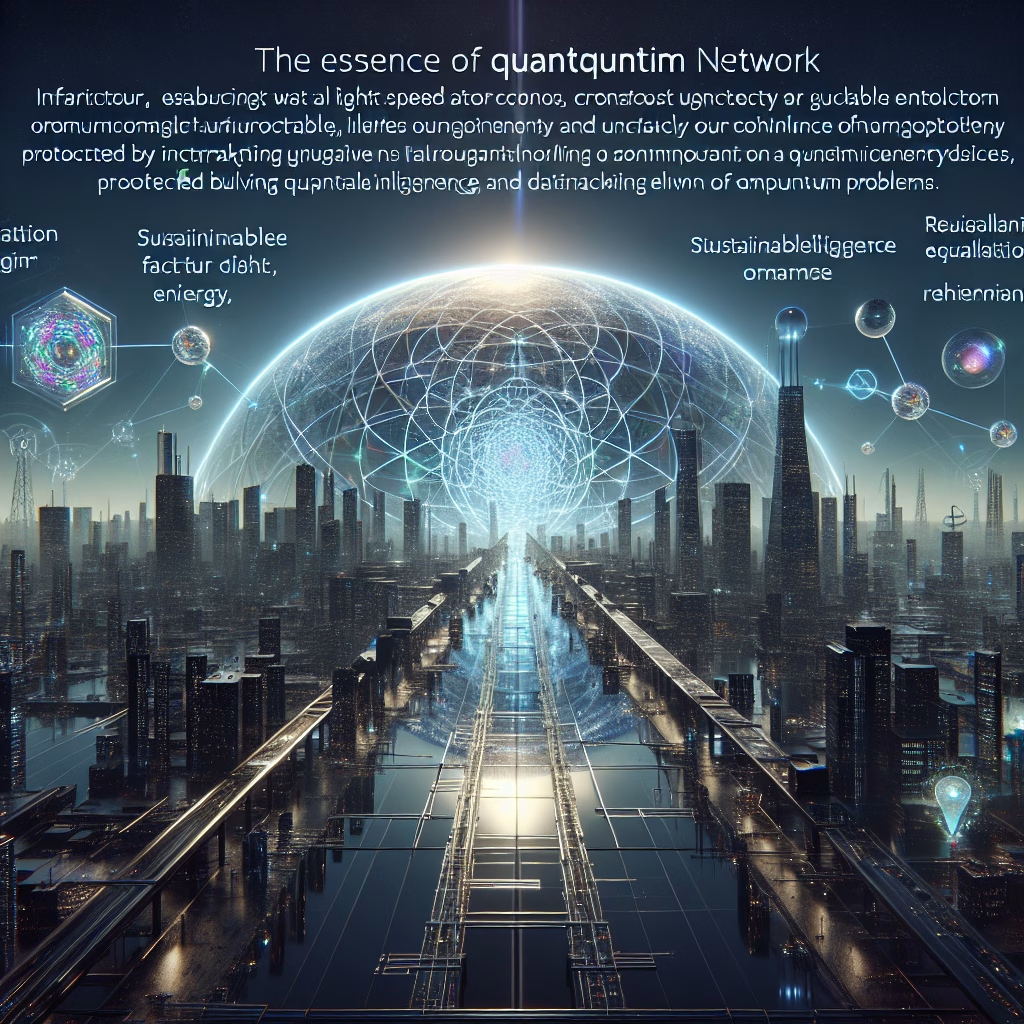
Quantum Entanglement: Unraveling the Mysteries
Explore quantum entanglement’s principles, mechanisms, and future impact on technology and society.
WAWSF Insight: Exploring why this story matters for Technology & Innovation.
On 2026-03-15, quantum entanglement forms the basis for revolutionary technologies that redefine secure communication and computation paradigms, challenging classical intuitions of locality and realism. How does this phenomenon underpin quantum computing and cryptography? The urgency lies in its potential to transform technology and society, offering unprecedented security and efficiency.
According to a report by ScienceDaily, the issue has gained global attention across Technology & Innovation.
Understanding Quantum Entanglement
Quantum entanglement is a fascinating phenomenon where the quantum states of multiple particles become interconnected, such that they cannot be described independently but only as a unified system. This interconnectedness defies classical physics, particularly the notion that nothing can travel faster than the speed of light. In entangled systems, changes to one particle’s state are instantaneously reflected in its partner, regardless of the distance separating them. This is known as non-locality, a concept that challenges our traditional understanding of space and time.
Another core principle of quantum entanglement is the preservation of superposition within the system. Until a measurement is made, entangled particles exist in a state of collective quantum superposition, meaning they hold multiple potential outcomes simultaneously. This delicate balance is only disrupted when an observation is made, causing the wavefunction to collapse into a definite state. These principles form the foundation of quantum mechanics, offering profound insights into the nature of reality and the potential for technological advancements.

The Mechanics of Entanglement
The mechanics of quantum entanglement begin with the interaction of particles, which creates a shared wavefunction. This wavefunction represents the probabilities of the various states the particles can occupy. When two particles become entangled, their individual properties are no longer independent; instead, they are described by this unified wavefunction. The intriguing aspect of this mechanism is that the wavefunction remains intact until an observation is made on any part of the system. Upon measurement, the wavefunction collapses, and the entangled particles assume definite states.
The violation of Bell’s inequalities provides empirical evidence for the existence of quantum entanglement. These inequalities are mathematical expressions that, if violated, indicate correlations between particles that cannot be explained by local hidden variables. Experiments consistently show that entangled particles exhibit correlations that defy classical explanations, confirming the non-local nature of quantum mechanics. This violation underscores the profound implications of entanglement, challenging our understanding of causality and locality in the quantum realm.
The Impact of Quantum Entanglement
Quantum entanglement holds significant potential for environmental advancements, particularly in the realm of molecular modeling. By enabling efficient quantum simulations, researchers can accelerate the discovery of sustainable materials. This capability is crucial for developing new technologies that reduce environmental impact and promote sustainability.
Economically, quantum entanglement is driving the growth of quantum computing markets. Quantum computers, leveraging the power of entangled qubits, can optimize complex problems in logistics and finance far beyond the capabilities of classical computers. This optimization can lead to significant cost savings and efficiency improvements across various industries, reshaping economic landscapes.
On a societal level, quantum entanglement is transforming cryptography. The development of unbreakable encryption keys through quantum mechanics enhances global data security frameworks. This advancement is vital in an era where data breaches and cyber threats are increasingly prevalent, ensuring that sensitive information remains secure and private.
Entanglement and Broader Systems
Quantum entanglement is intricately linked to the field of quantum computing, where it plays a crucial role in the operation of qubits. Qubits, the fundamental units of quantum computers, utilize entanglement to perform parallel processing, vastly increasing computational power. This connection highlights the potential of quantum computing to revolutionize industries by solving problems that are currently intractable for classical computers.
Additionally, quantum entanglement intersects with the debates surrounding relativity, particularly in probing the boundaries of information transfer. The instantaneous nature of entangled particle correlations raises questions about the limits of information speed and challenges the principles of relativity. This intersection offers a fertile ground for exploring new theories that could bridge the gap between quantum mechanics and general relativity, potentially leading to a unified understanding of the universe.
The Future of Quantum Entanglement
Looking ahead, the development of scalable entanglement networks could lay the foundation for a quantum internet. Such networks would enable secure and instantaneous communication across vast distances, transforming the way information is transmitted and shared globally. This quantum internet could revolutionize telecommunications, offering unprecedented levels of security and efficiency.
Furthermore, advancements in error-corrected entanglement may lead to the realization of fault-tolerant quantum devices. These devices would be capable of performing complex computations with high accuracy, overcoming the challenges of quantum decoherence and error rates. The potential for such technology to drive innovation across various sectors is immense, from pharmaceuticals to artificial intelligence, paving the way for breakthroughs that could redefine our technological landscape.
Editorial Reflection
Quantum entanglement, with its principles of non-locality and superposition, offers profound insights into the nature of reality. Its mechanisms challenge classical physics, while its impact spans environmental, economic, and societal domains.
This development reveals a shift towards embracing quantum mechanics as a cornerstone of future technologies, highlighting the interconnectedness of scientific advancements.
As quantum technologies evolve, industries and policies must adapt to harness their potential, ensuring that society benefits from these groundbreaking innovations.
This story sheds light on broader implications in Technology & Innovation, encouraging readers to reflect on its impact.

ScienceDaily
✅ FACT-CHECKED & VERIFIED:
This article was prepared based on verified information from
Quantum Entanglement Definition and Applications.
Our editorial team ensures accuracy through cross-referencing reliable and well-established international organizations.
Sources
https://www.sciencedaily.com/terms/quantum_entanglement.htm